

After PB’s demobilization from service in the First World War, he came under the influence of at least two important figures: Allan Bennett (Ananda Metteya), who is sufficiently well known, and a certain “Brother M.” Speculation on the latter was limited to the three books published under that pseudonym, to Michael Juste’s “occult autobiography” The White Brother (1927), and to a few hints in PB’s Notebooks. In 2021 I discovered a podcast that revealed Brother M’s identity, and acquired a collection of letters that included several written to Michael Juste by Brother M and his wife Aileen. This led to a biographical search through published documents and hints in M’s own writings, which are gathered here. Much remains to be discovered, especially the source of M’s own occult training, and information on his pre-war activities in Paris and London.
Among the early personal influences on PB, that of Brother M stands out as a master of the mysteries and techniques of occultism, and a careful protector of his personal identity. This investigation sketches what is currently known about his life, with a list of documentary sources. There follow excerpts from his writings, selected for what they may reveal about his biography and character.
Charles Willis Thurston, who was sometimes known as “Brother M” and wrote under the name of “M,” was born on May 18, 1872 to a well-established, middle-class, New England family (see Appendix I). His father was a manufacturer and inventor of small industrial and household items, with many patents to his name. We know nothing of Charles’s youth beyond the incidents related in his books, which with authorial privilege may be fact, fiction, or something in between. Part of his boyhood was spent in the Transcendentalist atmosphere of Concord, Massachusetts. He was on excellent terms with the Native Americans, about whom he had much to say in his second book (see Appendix II).
Thurston evidently trained as a painter, exhibiting at the Boston Arts Club in 1897. Travels in the Americas, Europe, and possibly beyond may have filled the following decade. His next, and so far only appearance as an artist was in a large group exhibition of American painters in Paris, 1908. He settled for some time in that city, living a “Bohemian” lifestyle of near-poverty but acquaintance with notables. He writes of hosting a visiting Yogi, of giving a party in his studio, and of meeting the sculptor Auguste Rodin and a famous “scientific benefactor” who resembles Louis Pasteur (died 1905).
Thurston had a spiritual master, mentioned with no indication of time or place, though the relationship seems to predate the move to Europe and to have continued into the 1930s. His writings acknowledge no individual, lineage, or group; nor do any other “Brothers” appear. If he lived in Paris around the turn of the 20th century, he would have witnessed the tail-end of the French Occult Revival and the rivalries of the various personalities and groups. He mentions none of these, nor any of the English magical orders such as the Golden Dawn, which he would have known of in London. He writes with complete independence and authority. Without claiming a direct influence, Thurston’s preoccupation with the Elemental beings, and the tales he tells of his interactions with them, call to mind the American occultist Thomas Lake Harris (1823-1906), founder of the Brotherhood of the New Life, who was likewise familiar with fairies and had a spirit wife, the Lily Queen.
By 1913 Thurston had a collaboration, at least, with a wealthy American widow, Sarah Emery Dudley (1878-1954, aka Lotus Dudley), who had been living in London since 1909. My article “The Brothers and the English Comte de Gabalis” outlines her career, fascinating both in the objective sense and in her power over people. Whether the Brothers already existed, or whether they were invented by Thurston and Dudley, is impossible to say without further evidence. They came to public notice in an expensively produced edition of Montfaucon de Villar’s novel Le Comte de Gabalis (first published in 1670), in which the Brothers’ emblem of three standing figures in an oval cartouche appeared no fewer than five times. The book is richly illustrated throughout with plates and line blocks, almost certainly Thurston’s own work, which show the influence of the Symbolist movement.
Sarah Dudley returned to New York after the book’s publication, to supervise an American edition that appeared in 1914. The subsequent history of Montfaucon’s tale, with its theme of marriage with Elemental beings (Sylphs, Undines, Gnomes, and Salamanders), is treated both in the article cited and in my edition of 2024. I concluded that Thurston proposed the project and contributed the esoteric part of the commentary, while Dudley translated it from the French, supplied the many pages of notes, and financed it.
In April 1913, Thurston and Dudley applied jointly for a U.S. patent for a book cover, designed with a slot into which a card could be inserted. The application was granted a year later, with a diagram that showed an open book unmistakably carrying the Brothers’ emblem. The invention was trivial, but it gave the Brothers a further claim to existence. A YouTube talk in 2021 by a person known only as “MtalksX” brought this to my attention, and with it the full names of Thurston and Dudley, enabling Internet searches for both of them.
Until further evidence appears, Thurston disappears from the public record until after the First World War. Here we turn to his relationship with PB, starting with some significant dates:
- 1919, June 19. PB adopts the surname of Hurst.
- In November, PB publishes his first contribution to The Occult Review (“Along the Mystic Road,” by Raphael Meriden).
- 1920, April 27. PB elected to membership of the London Theosophical Society, Astrological Lodge, sponsored by Michael Hurwitz.
- 1921, April 30. Thurston marries Aileen Winifred Cook.
- 1922, Summer. The Thurstons are in Ireland, where M writes two letters to Michael Hurwitz.
- 1922, September 5, PB marries Karen Augusta Tottrup.
- Comte De Gabalis appears in a new edition (New York: Macoy) naming Lotus Dudley as copyright holder, translator, and author of the commentaries, while the Brothers’ emblem appears but once.
- 1923, April 3, Kenneth Thurston Hurst born.
Michael Hurwitz (1897-1961), mentioned here as PB’s sponsor, deserves a separate investigation. Born in London of Lithuanian-Jewish immigrants, he wrote prose and poetry under the pen-name of Michael Juste. He officially changed his surname to Houghton, under which he founded the Atlantis Bookshop, still in operation near the British Museum. On Michael’s death the bookshop passed to his nephew, the eminent violinist Emanuel Hurwitz, CBE, who immediately sold the shop to its present owner’s family.
In 1927 Michael Juste published his first book, The White Brother: An Occult Autobiography. It tells of four flat-mates (the narrator, David, Paul, and an Irishman) leading a precarious existence in postwar Bloomsbury. Michael and David, who are drawn to Theosophy, come under the influence of an older adept called M. He lends them a copy of the 1913 Comte de Gabalis and enlarges on its doctrine of the Elemental Spirits and human relations with them. He watches detachedly as Michael and David are temporarily attracted by an evil magus called S, whose downfall they eventually bring about. The latter part of Juste’s book describes the occult adventures and astral travels that he claims to have taken under M’s guidance.
Although nothing in Juste’s roman à clef can be accepted as biographical fact without corroboration, the “David” character is clearly modeled on the young PB. Kenneth Hurst’s memoir confirms that Michael had been a schoolfriend of PB’s, and a partner in his first bookselling business. In his Reflections PB recalls his own, less extravagant experiences under M’s guidance. In Juste’s book, David leaves the group to marry, so if we trust anything about it, the action can be placed in the immediate post-war years.
We know nothing further of M in this period, beyond a pair of letters that he sent to Michael from Ireland in the summer of 1922, where he was holidaying with his wife, apparently in some comfort, and meeting important people. He reappears in 1924, writing to Michael from “The Studio, W & G.” This places him at Waring & Gillow, which occupied a huge building on Oxford Street. It was famous for furniture of all styles, including imitations of Oriental lacquered work. Kenneth writes: “Brother M specialized in painting lacquer and was employed by one of the largest department stores in London, which sent him all over the world to execute commissions for wealthy buyers.” (Paul Brunton: A Personal View, 62) Two snapshots in the PB archives are the only images so far known of him.
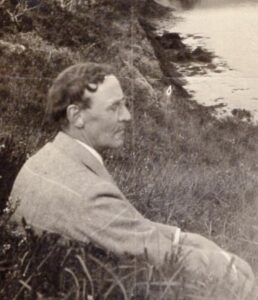
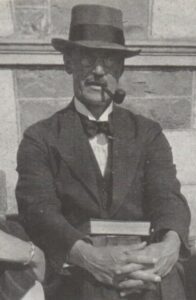
In 1930 the Thurstons bought a modest house in Peacehaven, six miles from Brighton. They may have had some kind of business there, perhaps a bookshop. In an undated letter Aileen thanks Michael for sending one pound, saying “We are jolly thankful to get it as things here are absolutely at a standstill, no one comes into the shop & it is just as if there was a curse on the place.”
The letters that Charles and Aileen Thurston wrote to Michael in 1930-31 are intimate and full of concern for their young friend. Thurston describes his own spiritual development under his peculiar terminology of “atoms.” The older couple tried to steer Michael through his infatuation with Cynthia Rawle, a girl from a somewhat higher social class. Sometimes he tried their patience. On March 25, 1931, Thurston breaks out: “So old Chap try not to think about yourself so much but try to buckle on your breast plate and meet the world again and do some good constructive work.” The episode reappears in Thurston’s posthumous book:
I once asked a student if he would like to go with me on a trip ‘out of the body.’ I took him across the sea into the wilds of North America, and the initiate left his abode among the tall trees to meet us. The student exclaimed, “He is an Adamite man. Do you see the light about him?” Then he suddenly turned to me and said, “Do you think that Cynthia loves me?” With that we came back to our bodies, and he had missed a most golden opportunity to bathe in an atmosphere of peace and intelligence. (The Lord God of Truth Within, 130.)
PB also tried to help Michael with his romantic life, visiting Cynthia Rawles’s house, playing tennis with her, and meeting her father (“he does not appear to be the monster you described”—letter of July 10, 1931).
To complete the circle, Thurston wrote to PB in an even more candid and intimate manner. A long letter from Peacehaven, typed on January 25, 1931, touched on three topics: Michael’s embarrassing behavior with Cynthia; PB’s prospective trip to India and the upset this has caused Meredith Starr, Meher Baba’s English patron; and M’s own work, now on a global scale:
The Great Atlantian—the Teacher of my Master has given me help and opened a new door for me to explore. The work is for our Western area and the ‘Atlantian’ and my Master are now in America living in the mountains in California. . . They have with them the Brothers’ Teraphim—a relic of Atlantian days and it has the Nous Atom of a Brother in its substance who is related to me. This is to be given to me, as its instruction is needed and one can get its vibration at times. (PB Archive, L11.029)
Michael, for all his shortcomings, was helping Thurston to get his own book into print. On August 19, 1931, PB asks Michael if he has finished working on it yet. The Dayspring of Youth appeared from Putnam in 1933, with illustrations of subtle bodies, a water spirit, and a “black magician.” Together with the decorations of Comte de Gabalis, these are the only known specimens of Thurston’s art. Michael remained devoted to his teacher, and would eventually collect, edit, and arrange for the posthumous publication of Thurston’s second book, The Lord God of Truth Within, published in 1941 by the Phoenix Press of Manly Palmer Hall.
We have at present no documents of Thurston’s life between these letters of 1931 and his death in 1937. Nor do we know how Aileen lived on through the Second World War until her death in 1953. The couple are not known to have had children.
Appendix I. Documented Biographical Information and Sources
Birth and Death
- Charles Willis Thurston, May 18, 1872-1937
- Wife: Aileen Winifred Thurston, 1889/1890-1953
Marriage
- April 30, 1921, Registry Office, St. Pancras District, County of London.
- Charles Willis Thurston, age 48, Artist/Decorator, residence 21 Doughty St., W.C.
- Father: Charles Holman Thurston, Inventor.
- Aileen Winifred Cook, age 28, Artist/Decorator, residence 21 Doughty St., W.C.
- Father: Henry Cook (deceased), Surgeon Major General (Indian Medical Service).
Parents and Wife
Frost Genealogy (online) gives Charles Holman Thurston (June 3, 1842-1929) and Amanda Caroline Frost (1842-1927), both of Marlboro, NH, married Nov. 23, 1864. Of their four children, the third is Charles W., born May 18, 1872.
Thurston Genealogies (online) confirm Charles Holman Thurston’s birthdate and parentage. It states that he was “one of the firm of Thurston Knob Screw Co. of Marlborough, with agency offices in Boston and New York City. He was the inventor of this Screw and of the machinery for the manufacture of them. He also invented the ‘Companion Sewing Machine,’ put into the market in 1879.” C. H. Thurston registered at least nine U.S. and Canadian patents for small items (pipe wrench, hand punch, bicycle support, etc.) between 1868 and 1905. His residence up to 1880 is given as Marlboro, New Hampshire; later as Boston.
Aileen Thurston’s father Henry Cook (1831-May 30, 1927), MD St MRCS MRGS MRMetS FRCP, JP, is well documented in obituaries in medical journals. He had a distinguished career in military expeditions (Persian, Abyssinian) and in Bombay, before retiring to Prior’s Mesne, Lydney, Gloucestershire and later to Lee-on-Solent. He had two sons and two daughters. Note that he is recorded on the Thurston-Cook marriage certificate as “deceased.
Aileen also ran a book business for a while. The London Gazette, July 5, 1932, p. 4381, lists “The Merlin Book Company; Aileen Thurston; second hand Books (Mail Order); 50, Royal Avenue, Chelsea, London, S.W. 3.”
Art Exhibits
The Boston Arts Club: Exhibition Record, 1873-1909, compiled and edited Janice H. Chadbourne et al. (Madison, CT: Sound View Press, 1991), 375: “Thurston, C. C. (See Thurston, Charles), April 11-May 2, 1896. Silver-Point (b/w).” “Thurston, Charles (possibly Thurston, Charles W.) American 19/20th cent. April 13-24, 1897. No. 221, Reverie (w/c), $75. Address: Grundmann Studios, Boston, Mass.”
“American Paintings in Paris,” New York Press, April 16, 1908, p. 10, accessed online. On the 18th annual exhibition of the Société des Beaux-Arts in Paris, 1908. A long list of the American section includes “Charles W. Thurston of Boston.”
Patent Application
US no. 1913761151A. Book cover. Filed April 15, 1913 by Charles W. Thurston and Sarah Emery Dudley. Published July 14, 1914.
Sources
The Archives of Paul Brunton. Kroch Library, Cornell University. Accessible online through the Paul Brunton Philosophic Foundation.
Brunton, Paul. The Notebooks of Paul Brunton, Vol. 8: Reflections on My Life and Writings. Burdett: Larson Publications, 1987.
Godwin, Joscelyn. “The Brothers and the English Comte de Gabalis.” Studies in Bibliography 61 (2025): 323-330.
Hurst, Kenneth Thurston. Paul Brunton: A Personal View. Burdett: Larson Publications, 1989.
Juste, Michael. The White Brother: An Occult Autobiography. London: Rider & Co., 1927. Reprinted Minneapolis-St. Paul:
The Wild Gander Press, 2022.
M. The Dayspring of Youth. New York: Putnam, 1933. Reprinted New York: Samuel Weiser, 1968.
M. The Lord God of Truth Within: A Posthumous Sequel to The Dayspring of Youth. Los Angeles: Phoenix Press, 1941. Reprinted Des Plaines: Yogi Publication Society, 1970.
Montfaucon de Villars, Abbé Nicolas. Comte de Gabalis. “Rendered out of French into English with a Commentary.
Published by the Brothers.” London: The Old Bourne Press, 1913.
Montfaucon de Villars, Abbé Nicolas. Comte de Gabalis. “Rendered out of French into English with a Commentary.
Published by the Brothers.” New York: Harry B. Haines, 1914.
Montfaucon de Villars, Abbé Nicolas. Comte de Gabalis. “Newly Rendered into English with Commentary and Annotations.”
London: William Rider & Son, 1922. (Remaindered sheets of 1913 edition with cancel title-page.)
Montfaucon de Villars, Abbé Nicolas. Comte de Gabalis. “Rendered out of French into English with a Commentary by Lotus Dudley.” New York: Macoy Publishing & Masonic Supply Co., 1922.
Montfaucon de Villars, Nicolas. Le Comte de Gabalis. Edited and partly translated by Joscelyn Godwin. Obernkirchen: Black Letter Press, 2024.
Appendix II. Biographical Hints in M’s Books
DY. The Dayspring of Youth
LGTW. The Lord God of Truth Within
“As a boy I lived in the farming community of Concord, Massachusetts, gathered mushrooms in Emerson’s front yard, and listened to the friends of Emerson and Thoreau relating anecdotes. These people were dear, cultured men and women of nature, living in an atmosphere impregnated with thought. As a boy I once told my uncle that I had read Thoreau’s books, but could not understand how he could possibly live on twenty-five dollars a year. My uncle answered that when he went on Sunday afternoons with Emerson to see Thoreau at Walden Pond, they always took him a basket of good things.” (LGTW, 198)
“When a student, I myself lost seven years of development through bestowing a power of nature on one whom I loved, who afterwards proved false to the keeping of this treasure: seven years of darkness and suffering!” (LGTW, 171-72)
“The writer spent nine months of hard work, living practically a hermit’s life out of contact with humanity in general, and regarded it as a failure. After a year’s interval he again attempted this union with nature, and after persevering for twelve months he came to the conclusion that it was beyond his power of achievement, so he renounced all desire to attain that union. Having renounced his desire, he suddenly felt himself being slowly born into the consciousness of nature without effort. Then he was given instruction and permitted to observe movements in nature known only to the adept.
Years before, while living among the red Indians, the writer had realized that some of them were in constant rapport with something in nature which he could not observe.” (LGTW, 324)
[On entering nature’s consciousness] “It took the writer a year and nine months of practice and hard work, living close to nature, before he could receive the instruction and be worthy of the notice of these overlords of nature.”
“The hermit life has its compensations and they very often come, as they did in the writer’s case, after the quest has been renounced as hopeless.” (LGTW, 178)
“I remember once when I had lived as a hermit upon a hillside far from man, and was about to return to the world, having failed to gain what I had been seeking, that a Being, clothed like an ancient Druid, stood beside me…” (DY, 236)
“I was once privileged to sleep for six months in a hut in a churchyard and my work, each night before going to bed, was to go through the churchyard to break, when merited, the linga sharira thread which held the astral body to the corpses.” (LGTW, 171)
“We ourselves have been sent into strange countries and places for similar purposes. We are never commanded to do this or even told what we are to do; only later does the reason for such action dawn upon us.” (DY, 115)
“Often, among some of the colored races the fetish of an old stocking on a crooked stick before my tent caused the fear of God to enter the heart of the native, and my belongings were not molested.” (LGTW, 271)
“When I eventually met my teacher, I found kindliness, patience, and a loving heart… After this first meeting I realized my supreme ignorance of myself, my mind, my body, and my higher self. Although I was, as I thought, physically fit at the time, I had to go through a year’s hard training in physical culture and had to study dissection.” (LGTW, 103)
“…the great men I have been privileged to meet and associate with have been invariably sensitive, shy, and simple, and did not exhibit their wonderful powers or attainments unless necessary to do so.” (DY, 145)
“Personally, I consider that the three most cultured beings I have ever met, and in whose society I felt most happy, were people who eat their food with their fingers, yet there was such culture and refinement in their hands as I have never seen at the tables of so-called epicures in old titled families. These three great souls had attained God Realization, and were working for humanity. One of the three had his home in the desert, and I still remember his hearty laugh, and his atmosphere…” (LGTW, 106)
“I was once privileged to go to the retreat of some brothers, which was protected by elemental nature… it took me half a day to cross the valley, and another half day to find my way up the pathway along the face of the cliff… There are only seven members in this retreat and they have records of those whose life experiences they consider to be of use to humanity and their observations reach back into the remote past… I learned some unknown things about Rembrandt and Botticelli, and found a missing fragment by a great artist, which has been a puzzle to the critics of today.” (LGTW, 142-43)
“The sun elemental has power over mind stuff matter [sic] and will often transform itself into a golden lion, which you may sometimes see sitting on your mantelpiece, radiating rays of crackling, brilliant sunshine. Before the beginning of the Great War, three of these elementals walked around my bed, wearing Sam Brown belts, as humans would wear them, and they projected a picture of a well-known railway station, with many troop trains departing.” (LGTW, 179)
British Isles
[Story of a lady and her child who could not stand sunlight.] “Other symptoms developed and the lady was in a London nursing home, when I was asked, if possible, to diagnose the trouble. The doctor and I were at dinner, when the nurse told the doctor of the recurrence of the attack. . . There in a corner, sitting on its haunches, was a being from the world of Pan, half-human, half-dog, with terror-stricken eyes.” [After curing the child] “The Pan entity had also to be succored and I did not get into bed until three o’clock one night, for I had to take the poor Pan creature back to his own element.” (LGTW, 60)
“Visiting the cathedral towns of England, we walk into the glamour of the past, but even in those places where the light has been bright, we can get only the shoddy impress of the past today, for the debris of the ages has not the intelligence of experience.” (LGTW, 175-76)
“I have found culture in the hut of a Cape Cod fisherman, and among the shepherds and weavers of the Highlands of Scotland. Often these people are a challenge to one’s intelligence.” (LGTW, 197)
“Again, there is a beautiful strip of shore in the Highlands of Scotland which, until recently, little children avoided if possible. Living in the district, I had been awakened a number of times by a cool hand placed upon my forehead…” (LGTW, 62)
“I once knew a man in Scotland who would not walk on the main road, but preferred to tramp over ploughed fields and ground to the post office half a mile away. I once said to him, ‘Jock, why is it that you will not walk in the road at night?’” (LGTW, 174)
“A friend of mine, a sylph, using our language, said that he had three suits of clothes. He taught me how to call him in a beautiful garden in the Highlands of Scotland…” (LGTW, 296)
“In Scotland one of these friendly gnomes accurately described to me the treasure chest of an old Scottish family…” (LGTW, 224)
“Whenever I told him that I was going to Ireland, he would dance with glee and go through a pantomime showing the pains and sorrows of the poor people there.” (LGTW, 225)
Continental Europe
“Sometimes in one’s travels, or through circumstances, one finds oneself in a room or place where the inhabitants are evil and licentious, and distrust in others abounds. To the sensitive, it seems as though he could cut the atmosphere with a knife. You find this condition mostly in old Continental cities and in old hotels, magnetized by mental and physical entities of the worst kind.” (LGTW, 297)
“I am thinking now of a great soul, a scientific benefactor whose statue, erected by loving hearts, adorns a public place in Paris… When I first met him, I felt his cultured distinction, but when he began to speak with authority about things of which I was ignorant, I thought that perhaps he was a ‘crank,’ yet I can never forget the look back of his eyes, the look of realization and sacrifice, nor the atomic link of love which can never be broken. I was young then, and so ignorant!” (LGTW, 131)
“If one seeks to reveal that for which the world is not ready he is warned three times, and if persists he is removed.
This once happened to a great soul I was privileged to know, though I was ignorant of his name at that time, or the great work he did for his country, till after his death.
He met me apparently by chance in a foreign country, and only afterwards did I realise that he travelled a long distance to meet me and welcome me… I was very poor and living the life of a student. Yet whenever I had ordered a fire to be lit that winter, I found him in my room on my return from an evening class.” (DY, 296-67)
“A businessman once came secretly to my rooms in Paris to meet a Yogi student and he told me he had found peace for the first time in years.” (LGTW, 138)
“A lady once came to my studio in which there were many distinguished people. My intuition told me at once that she had need of my services, but when she left, my friends gathered around me and said that they all disliked her appearance…” (LGTW, 100)
“Knowing some of the incarnations of a friend, a man of great distinction, I took him to an out-of-the-way place in Paris and stood him over the floor of a dungeon wherein he had been confined and died in another life.” (DY, 283)
“A business deal considered honest in one country is judged dishonest in another. You will quickly discover this if you travel through the countries bordering on the Mediterranean…I know one country intimately where two persons who are friends socially, will think it very clever if one of them can best the other in a business deal. The old New England canon of doing business by word of mouth has passed into obscurity…” (LGTW, 139)
“Henri Martin, the painter, once pictured a procession of people crossing a desert, each carrying upon his back his own chimeras, the financier his money-bags, the artist his model, the roué his courtesan…” (LGTW, 63-64)
“I have watched Rodin, the sculptor, run his fingers lightly over the neck of a princess, and then pass his finger over the marble in its nearly completed state, and I have felt the strength of the Titan’s hand behind the lightness of his velvet touch. When she had gone he turned to me and said, opening and shutting his hands…Then he went on to speak with enthusiasm of the Boston gentleman, his first real patron who gave him, as he said, his first real freedom. Perhaps that was the reason he was always kind to American students.” (LGTW, 122-23)
“Once, when I was living in Italy, I was wondering what the plague looked like, when suddenly three shining beings appeared.” (LGTW, 153)
Native Americans
“When I was living with a tribe of red Indians in America I discovered that they had nine-tenths vision.” (LGTW, 14)
“I have met some members of the red Indian tribes who have what is known as nine-tenths vision, for they can see clearly at night things which escape the observation of most men.” (LGTW, 173)
“Years before, while living among the red Indians, the writer had realized that some of them were in constant rapport with something in nature which he could not observe. The student will understand that there are realms of consciousness and activity not generally known, but which may be explored through effort in Yoga, but that this finer and higher knowledge can only be taken by forceful preparation and patient waiting.” (LGTW, 324)
“A red Indian initiate will often say, ‘The king of the beavers is about to speak,’ and it is from this source that the Indian gets his knowledge of the laws of the beavers. These laws show how men should live.” (LGTW, 34)
“The red Indian has often received devic instruction through some animal, and the laws governing its species… The devas are beings who watch over the development of different divisions of nature’s elements, and they taught the red Indian the Law.
A great red Indian soul demonstrated his power over animals, called rabbits out of their holes, and stroked the wild deer in the forest… He told me that if only the white man had the graciousness of heart to approach the red Indian properly, he could receive much knowledge of great benefit to him.
The great avatar who appeared to the Indians in the eastern part of the United States, taught the initiated the written language, and they still have two books in their possession which, in some future period, as the devas wish, will be made known to humanity. The law of karma (cause and effet) will some day return justice to the Indians, and to the yellow race as well…” (LGTW, 55)
“There are several places in Egypt where records relating to Atlantean history are hidden: also those dealing with America after Atlantis, and the coming of a great Initiate to the Red Indians on the Eastern coast; who taught them agriculture and gave them an alphabet, leaving two books that are still in the possession of an initiated Indian.
The Indians at that period possessed a code of morals and social laws undreamed of by those who came after, and in the future, when the Red Indian has established himself within his own territory, they will be brought to light. In those days these Indians were living simply, without destroying animal life unnecessarily. They cultivated the soil and the tribes lived in harmony. But a little later a foreign people swarmed in from the Caribbean Sea and forced them to take up arms, and ultimately severed the tribes from their previous unity.” (DY, 306-307)
“The mixing of other races with the native inhabitants of a country brings about a deterioration in the original native strain, for the parental stem is changed by the introduction of a foreign element, hence the progeny lack the stamina found in either species.” (LGTW, 149-50)
“The Indians were far wiser than the white man, for they did not recklessly destroy. The early white settlers exterminated the buffalo, and dug up the buffalo grass to plant wheat.” (LGTW, 196)
“We are privileged to know a great soul, a native red Indian, who has a knowledge of nature’s laws and remedies which science today would probably decry. He is a man who can do things which doctors are at present unable to accomplish. He once said to me, ‘If the white man had the graciousness of heart to approach the red Indian rightly, he might be given assistance which would prove of great benefit to his race. In the early days we were given missionaries and whiskey, and were driven out of our lands by the greed of the white man, but we are re-incarnating at this present time into the white race, and some day we shall regain that which we have lost—but we hold our knowledge secret until the time nature shall call it forth.’
“The great souls among the red Indians today can produce the same type of phenomena which we hear of from Tibet and India, but their knowledge is adapted to their own climate and country.” (LGTW, 289-90)
“Once when I was talking to a great red Indian initiate, he said, ‘Our Indian souls are incarnating into American bodies today and if you will study the faces of the white people in the Middle West, you will find the characteristic features of the Red Man, the feminine mother eye, and the male jaw and cheek bones. I recognize a Red Man in a white body as easily as the scientist does the geological formation of a country. In the future these Indian ‘white men’ will respond to the Indian call for Truth.” (LGTW, 363)
Appendix III. Evidence from Letters in a Private Collection
A small cache of letters written to Michael by the Thurstons, PB, and Frederick Fletcher was discovered in 2020 in the archives of the Atlantis Bookshop.
August 1, 1922. M writes to Michael Houghton from Ireland, where M is holidaying with Aileen. Stays in good hotels, meets “very distinguished” people, one of whom he is sure will be President of Ireland in twelve years. Concerned with state of the country after the recent troubles.
January 1, 1924. M writes to Michael Houghton, giving address as “The Studio, W & G.” This was Waring & Gillow, which occupied a huge building on Oxford Street. The store was famous for furniture of all styles, including imitations of Oriental lacquered work. KTH writes: “Brother M specialized in painting lacquer and was employed by one of the largest department stores in London, which sent him all over the world to execute commissions for wealthy buyers.” (Paul Brunton: A Personal View, 62)
May 30, 1930. M writes to Michael Houghton, from 124 Cheyne Walk, London, S.W.10.
Cheyne Walk had long been favored by artists, most famously by Dante Gabriel Rossetti at no. 16. From 1921-1942, no. 124 was the address of Benjamin Clemens, sculptor and art teacher.
October 17, 1930. M writes to PB from 124 Cheyne Walk. No biographical information.
December 2, 1930. M writes to Michael Houghton from “Clouds,” Peacehaven, Telscombe Road, Sussex. Has built a “ship’s cabin” under the house to avoid inclement weather.
March 25, 1931. M writes to Michael Houghton from Peacehaven. “There is so much to do about the place and we wonder if we will be able to enjoy it after all our work.”
The Thurstons’ experience bears out the judgment of Roland B. Harris, (The Peacehaven Historic Character Assessment Report, November 2004): “Peacehaven has retained its notoriety for bad planning, bad design and damage to the natural environment.”
Aileen Thurston’s letters to Michael are undated, but evidently from the same period of 1930-31. These excerpts give some insight into her life with M.
“At present things are in such a hopeless mess that life seems rather like standing in the middle of Piccadilly circus, with everything going round & round & round. M. of course blissfully does nothing, so I am unable to make any decision. He gets messages from Moon Gods (as he is going into the lavatory!!) but does not seem able to give me anything practical to work on. Often I wonder whether I am living in a nest of lunatics & am one myself.”
“I hear M talking in a loud voice to the Gods in the cellar, & occasionally I wonder if we are both batty & don’t know it. All inspiration is denied me. I feel simply tired out with all the cooking cleaning etc., nothing in the world is so complicated as the simple life.”
“He is such a dear, I only wish he looked better, but I suppose all this mental strain etc. must have an effect, & I get worried about him sometimes. The Gods should not put ewe lambs in this world unless they give them a comfortable & very woolly coat. In the modern world it is impossible to have a soul unless one has an income.”

Czech

Spanish

Portuguese