

Like my other “investigations,” this is a work in progress, undertaken in the hope of clarifying some of the mysteries that PB has left behind. In 1987, after the publication of PB’s Notebooks supplied some hints about the Mongolian philosopher mentioned in his later books, I wrote a speculative article for the journal Theosophical History (see note 19). Almost four decades later, papers in Cornell University’s Kroch Library allowed for the correction and expansion of my earlier surmises. They introduced a pair of characters with quite a well-documented history, though their philosophical influence on the already mature PB is beyond my competence to explain.
Alert readers of The Hidden Teaching Beyond Yoga will have noticed this sentence: “Both silent texts and living voices which have informed our writings are mostly Indian, supplemented by some Tibetan documents and a personal Mongolian esoteric instruction.”1 On progressing to The Wisdom of the Overself, other hints soon appear: “The Ariadne’s thread which finally led me through this metaphysical maze was indeed placed in my hands while visiting Cambodian China where I encountered amid the deserted shrines of majestic Angkor another visitor in the person of an Asiatic philosopher. From him I received an unforgettable personal esoteric instruction…” and “According to the testimony of this philosopher who personally initiated me into the Yaka-kulgan (Mongolian) metaphysical school, which studies a particular phase of this doctrine…”2
These passages create a mysterious aura around PB’s Mongolian initiation. “Yaka-kulgan” is a most obscure term. Even now, a Google search yields only PB’s usages, with one exception: Sir Charles Eliot’s Hinduism and Buddhism: An Historical Sketch, first published in 1921. We learn there that Yaka-kulgan is simply the Mongolian for Mahayana (the Greater Vehicle of Buddhism)3. Thus it was an initiation into a philosophic system of which PB could hardly have been ignorant.
Who was the initiator? Some hints had already appeared in a British psychic journal, The Modern Mystic: a trio of articles by PB titled “Night over Angkor,”4 “A Wanderer in Angkor,”5 and “The Secret Doctrine of the Khmers.”6 They introduced a cast of characters:
(a) The “Highest Buddhist Lama,” who placed the key to Angkor’s mysteries in PB’s hands and bade him give hints of it to the West. He is company with a younger disciple.
(b) A young Siamese man who boarded the ship at Kobe, and gave PB a letter that caused him to break his journey in Siam.
(c) In Bangkok, the Supreme Priest of Siam who received PB, promising orders to follow.
(d) A tall gray-bearded Buddhist monk, not Siamese, initiated 40 years ago in Mongolia, who told PB to go to Angkor.
(e) The oldest of a group of bonzes, met in the ruins of Angkor, who told him the place’s history.
(f) A High Lama, unnamed because his life is in danger, met somewhere in South Asia, who told PB about Blavatsky’s early adventures and the part played in them by Aghvan Dorjieff.
Given the style of PB’s travelogues, one doesn’t know which of these was real, semi-real, or invented for literary and didactic purposes. Nonetheless, somewhere backstage there was an event of some importance to PB’s philosophical development. We can at least date it, thanks to his correspondence with V. Subramanya Iyer, to whom he told his dates of travel in the region:
Dec. 23, 1938, sails from Los Angeles to Japan.
Delayed in Japan, thence to China, Siam, Cambodia.
Feb. 21, 1939, arrives in Colombo (Ceylon).
Mar. 12, 1939, arrives at Ramanashram.
Thus the encounter took place in January or February, 1939. Whether it happened in the ruins of Angkor, or whether that was a creative writer’s scenario, is immaterial. In the above cast of characters, the best candidate is either (d), the old Buddhist monk, or (f), the High Lama who knew so much about Blavatsky and Russian affairs—or perhaps a compound of both. That was as far as speculation could go until PB’s archive became accessible.
We now know who was behind those tantalizing hints, if only to leave us with further enigmas. In four departments of the PB Archives (Talks in the Orient; Carbons 04 (Asiatic); Buddhist Studies; Mahayana Notes) there is material ascribed, without further source, to MAHATCHARYA VAHINDRA and his chela, ANANDA MAITREYA BALTARI.7
A note in PB’s hand dates one of these talks (the one predicting war) to February 1939, agreeing with the chronology above. The talk states that Vahindra and Aghvan Dorjieff [1853-1938] were co-advisors to the Dalai Lama XIII: Dorjieff for Asiatic and European policy, Vahindra for European foreign policy only. Vahindra adds that he has had no influence in Tibet since the Dalai Lama’s death [Dec. 17, 1933].
As for Vahindra’s disciple, PB writes (Talks in the Orient, 265) that Ananda Maitreya Baltari was the son of a Chinese princess and Baron Ungern-Sternberg (1886-1921). Was this even plausible? The Wikipedia article on the notorious Ungern states that in July 1919 he married a Manchurian princess called Ji, aged 19, in an Orthodox ceremony in Harbin. She took the name of Elena Pavlova. Their only common language was English. They divorced in 1920. Thus Vahindra’s young disciple could only have been in his late teens when PB met the pair. However, this fairytale did not stand up for long.
The identity of the pair was in fact no secret. They were well known in Buddhist circles, even in English, as witness their then recent article (April 1938) on “The Problem of Time and Space” in a prominent Buddhist journal8. It calls them: “The Right Reverend Sthavira Bhiksu Mahatcharya-Vahindra, alias Karlis Tennisons,” and his disciple “The Reverend Nava Bhiksu Ananda-Maitreya-Baltari, alias Frederick Voldemar Lustig. (Latvian Buddhist priests).”
A Note from a Correspondent in the same issue adds:
Mahatcharya Vahindra entered the Holy Brotherhood of Lord Buddha 45 years ago in the celebrated Burkhutschinsky Buriat-Mongolian Buddhist Monastery, in Transbaikalia, on 8th of August, 1893. The ordination of a European into Buddhist priesthood, heralded as it was by Tibetan and Mongolian Lamas, was an extraordinary event in that part of Asia almost half a century ago, and gave occasion to a pious demonstration on the part of the inhabitants in Transbaikalia, who turned out en masse to see Mr. K. Tennisons enter the Holy Brotherhood of the Fully Enlightened One.
Latvian Buddhist high priest has spent much of his life wandering and teaching the Buddhist doctrine in many countries, from icy polar regions of the north to the most remote tropical countries. He devoted his life to the True Learning, and always emphasized the need for the recognition of the role of Buddhist religion in modern life.
Reverend Sthavira Bhiksu Mahatcharya-Vahindra lives at present with his European disciple Bhiksu Ananda-Maitreya-Baltari (F. V. Lustig) in Bangkok, Lumbim Pagoda, Siam.9
During the war years, Tennisons and Lustig continued to write for Buddhist journals in India, England, and perhaps their respective homelands, Estonia and Latvia. We find, for example, Reverend Sthavira Bhiksu Mahatcharya Vahindra and the Reverend Nava Bhiksu Yuvatcharya Ananda Maitreya Baltari, as authors of “The Great Milarepa of Tibet.”11 PB’s Mahayana Notes trancribe three more articles: “The Buddha” (Buddhism in England, 1939), “Guru Atisha of Tibet” (Buddhism in England, 1940)11, and “Nagarjuna: Exponent of Relativity” (Buddhism in England, 1941). This journal, later titled The Middle Way, was the quarterly magazine of the Buddhist Society of Great Britain and Ireland, founded in 1907 as part of the mission of Allan Bennett (1872-1923), known as Ananda Maitriya or Metteya. This associates the pair with the circle of English Buddhists, to which PB had belonged as Bennett’s assistant.
Today we know much more about these Baltic Buddhists, who have Wikipedia pages of their own: Vahindra’s under Karl Tõnisson (1883-1962), an Estonian by origin12, and Ananda’s under Friedrich Voldemar Lustig (1912-1989), a German-speaking Latvian. Mait Talts, an Estonian scholar, has researched their history thoroughly, though perhaps not including the PB connection. Here is the abstract of one of his articles.
This article is about the life and undertakings of two interesting personalities—Karlis A. M. Tennisons (1883–1962) and Friedrich V. Lustig (1912–1989). The Former (known in Estonia as “Barefoot Tõnisson”) has become a kind of a mythological personality and part of modern folklore. Around 1910–1911 he was the first person to begin to promote Buddhist teachings in Estonia and Latvia. During his lifetime he constantly changed his autobiography. During the 1950s while Tennisons was living in Burma, the final “official” version crystallized thanks to his disciple Lustig. In 1930 the two met and left the Baltics together for France. A year later they travelled to the Far East, staying first in Thailand. In September 1949 they were expelled from Thailand to neighbouring Burma for political reasons. During their Burmese period Tennisons gave himself the “Western-sounding” title of the Buddhist Archbishop of Latvia and Sangharaja for Estonia and Lithuania, which was generally acknowledged by Buddhists worldwide. Although first perceived as “odd figures”, they gradually managed to achieve the acceptance of the local lay population and influential Buddhist monks, and became “part of the local Buddhist inheritance”. This article gives an overview of years of research aimed at revealing the trustworthy biographical facts regarding Karlis Tennisons and Friedrich Lustig from a historical perspective in order to attempt to analyse their personalities. Nonetheless they were the very first people in Estonia to begin publically spreading Buddhist teachings and follow the Buddhist way of living, thus they deserve to be taken seriously as an object of academic study.13
This information puts Tennisons and Lustig in a position to have met PB as he stated, and to have had the talks that he recorded. I conclude that the Mongolian philosopher was Karlis Tennisons, and that he served as the model for characters (a), (c), and (f) in PB’s semi-fictionalized accounts.
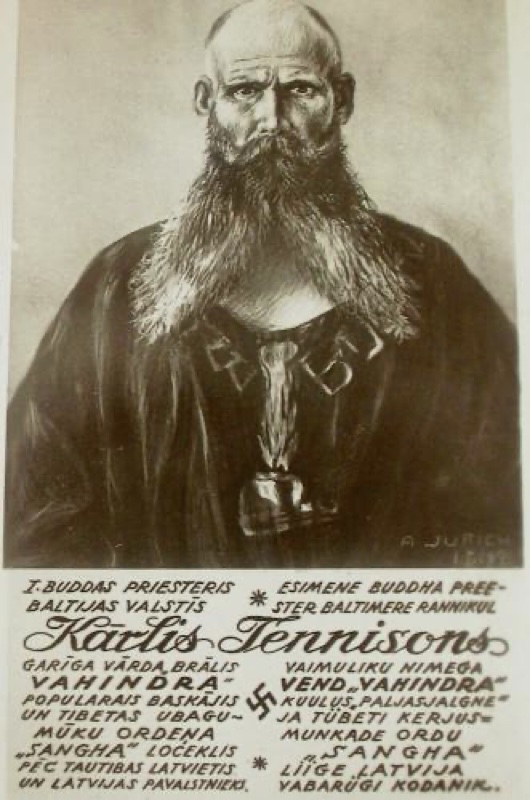
Karlis Tennisons, from a newspaper article, 1929
Another biography from one of Tennisons’ countrymen14 has the Archbishop ordaining the 18-year old Lustig at the Buddhist temple in Riga on November 27, 1930. The next day they left for Asia, hoping to reach Tibet; but first they stayed for a whole year in France, studying Oriental languages in Paris and enjoying hospitality on the Riviera. Not until November 1931 did they sail from Marseilles, passing through Suez, Djibouti, Ceylon, Singapore, and arriving in Bangkok on December 31, 1931. There the inseparable pair stayed for eighteen years in royal monasteries, until political pressures forced them to leave for Burma in 1949. They spent the rest of their lives in Rangoon.15
That is where Kenneth Thurston Hurst met them, while on a business trip to the Far East in the fall of 1959. He writes:
While in Burma, I tried to find out about Bud’s [Frederick Fletcher, the subject of a separate investigation] life there. I knew he had died a few years earlier. But it was not until a few days before I was due to depart that I was told about the two European monks living in the Swedagon Pagoda who might have known this other foreigner, the Venerable Dorje Prajnananda. They knew my father for he had met them, together with Bud, during this trip to India in 1931.16
Tennisons and Lustig took Kenneth to see the hut where Prajnananda had lived, and entrusted him with the task of bringing half of his ashes back to London. From Prajnananda’s obituary we know that his cremation in December 1950 had been presided over by Tennisons himself.17
Had Tennisons met Prajnananda before his final years? It is possible, but we cannot tell where or when. Even present-day scholars have difficulty with a character who, in Tait’s words, “constantly changed his autobiography.”
Kenneth’s report came from one last-minute meeting, under who knows what difficulties of communication. Regarding its last sentence, PB and Bud Fletcher cannot possibly have met Tenissons and Lustig in India in 1931, because as shown above, the Baltic pair were still in Europe for the whole duration of PB’s first Indian trip (November 1930-April 1931). However, there is every reason to believe that they met during the winter of 1938-39 in Siam and perhaps Cambodia. That Kenneth met one or both of them in Rangoon is confirmed by the exquisitely calligraphed letter addressed to “The highly esteemed Mr. Kenneth T. Hurst” on August 3, 1966, signed by “The Most Rev. Friedrich V. Lustig, The Buddhist Archbishop of Latvia.”18 (The archiepiscopal honor had passed to him on his master’s death.) Kenneth replied courteously to its request for help in publishing Lustig’s 600-page biography of Tennisons, and seems to have made an earnest though futile effort. The manuscript is now in the Estonian Library of Australia.
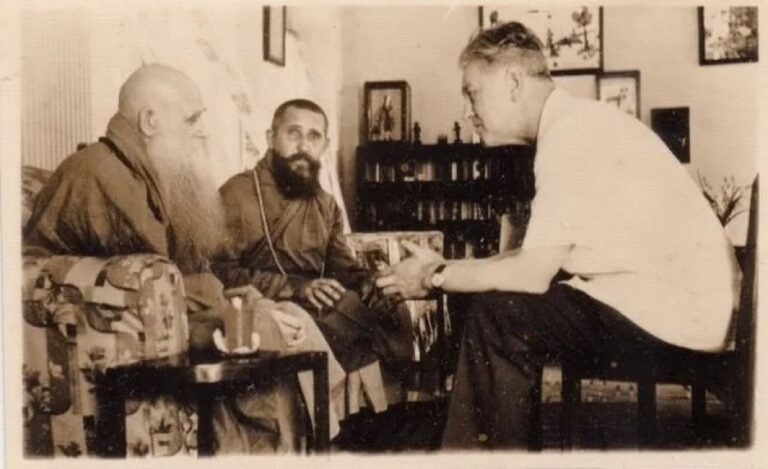
Karlis Tennisons, Friedrich Lustig, and a visitor, 1950s? (Aro-Ats Aasma, Six Days before Pearl Harbor, p. 41)
When PB’s Notebooks were published, I was struck by the “Mongolian’s” narrative about Madame Blavatsky’s early history and the connection with Agvan Dorzhiev, and wrote an article for an academic journal drawing attention to this new source.19 Much more information emerged in 1993, in a book on Dorzhiev by John Snelling, former General Secretary of the Buddhist Society.20 This did not mention Blavatsky, but it had much on Tennisons and Lustig. Years later, when the PB Archive became accessible and searchable, more pieces fell into place. The Blavatsky-Dorzhiev connection remains an unprovable but seductive theory, while relations with PB are to some extent clarified. But is it not extraordinary that the keystone to his philosophical system came to him from Mongolia, via Transbaikalia, through the mouths of an Estonian and a German-Latvian, wrapped in a web of evasion and pretension? And with all his reading and learning, was this really the first he had heard of Mahayana?
Obviously not: but what he received from Tennisons and Lustig is quite different from what one finds in writings on Buddhism, whether scholarly or popular. Only a part of it was published in the Notebooks. On the one hand it takes Buddhist teaching up to its limit of pure mentalism, beyond any theological or even metaphysical concepts (there being no distinction between the physical and the non-physical). On the other hand, it relates it to practical life and the path to enlightenment. In between, there is non-essential but interesting information about history, cosmology, Theosophy, Hinduism, world wars, animals, plants, and the fate of peoples today. Everything about it is eminently sane, with none of the eccentricity one might expect from these Baltic “bishops.” Readers familiar with The Wisdom of the Overself and The Orient (Notebook vol. 10) will recognize many resonances and near-quotations. It would be a worthwhile exercise, though beyond the scope of this biographical investigation, to make a sentence-by-sentence comparison, identifying these echoes.
The question it leaves in my mind is how these pages came into being. They are in almost perfect English. Was Tennisons or Lustig the main speaker? Do they represent conversations exactly recalled by some feat of memory? Notes taken on the spot in script or shorthand? Edited for grammar and style? Typed up afterwards by PB or a secretary? Retyped for the present notebook and its carbon copy, with handwritten notes added later? When matters of such philosophical and biographical importance are concerned, one would like to know exactly how their transmission took place.
1 Paul Brunton, The Hidden Teaching Beyond Yoga (New York: Dutton, 1941), 100.
2 Paul Brunton, The Wisdom of the Overself (New York: Dutton, 1943), 14.
3 Sir Charles Eliot, Hinduism and Buddhism: An Historical Sketch (London: Routledge & Kegan Paul, 1954): II, 3n.
4 The Modern Mystic, 3/7 (Aug. 1939): 286-90.
5 The Modern Mystic, 3/8 (Sep. 1939): 312-15.
6 The Modern Mystic, 3/9 (Oct. 1939): 355-56, 378.
7 Talks in the Orient, 265-319; Carbons 04 (Asiatic), 427-77, which are not quite identical, and lack PB’s handwritten comments; Buddhist Studies, 102, 80-86; Mahayana Notes, 444, 447, 467. Incidentally, the only Western authority cited here is another book of Charles Eliot’s.
8 The Maha-Bodhi, 46/5 (April 1938): 193-200.
9 Ibid., p. 413.
10 The Maha Bodhi 48/4 (April 1940): 111-13. (Internet Archive)
11 Compare the references to Einstein’s theory of relativity in The Hidden Teaching.
12 This is the Estonian version of his name. Tennisons is Latvian.
13 Mait Talts, “Karlis A. M. Tennisons and Friedrich V. Lustig – the first ‘practicing’ Buddhists in Estonia.” In: Peeter Espak, Märt Läänemets, Vladimir Sazonov, eds., When Gods spoke. Researches and Reflections on Religious Phenomena and Artefacts. Studia in honorem Tarmo Kulmar. Studia Orientalia Tartuensia, Series Nova, Vol. 6. Tartu: University of Tartu Press, December, 2015. Accessed online.
14 Aro-Ats Aasma, Six Days before Pearl Harbor. A Biography of the First Western Buddhist Monks, Karl Tõnisson-Kārlis Tennisons-Vend Vahindra and Friedrich Voldemar Lustig- Ashin Ananda. October 22, 2022. Accessed online.
15 The same source explains Lustig’s different names. His first Buddhist name was Ananda Maitreya, which he kept at least until 1959. It is curious that he chose the same name as Allan Bennett (written variously Metteya or Maitreya, depending on whether Pali or Sanskrit). Later he was known as Ashin Ananda or A Shin Ananda.
16 Kenneth Thurston Hurst, Paul Brunton: A Personal View (Burdett, NY: Larson, 1989), 144,
17 See the ongoing investigation of Frederick Fletcher (Prajnananda).
18 KTH letters 1966-71, pp. 51-53, 95.
19 Joscelyn Godwin, “H.P.B., Dorjeff, and the Mongolian Connection,” Theosophical History 2/7 (July 1987): 253-60).
20 John Snelling, Buddhism in Russia; The Story of Agvan Dorzhiev, Lhasa’s Emissary to the Tsar (Shaftesbury: Element, 1993).

Czech

Spanish

Portuguese