

This investigation concerns a character who played a significant part in PB‘s life. Immediately after the First World War, as a fellow member of the London Theosophical Society1, he may have introduced the young PB (then known as Raphael Hurst) to Fletcher‘s fellow Buddhist Allan Bennett, whom PB served as secretary and acknowledged as one of his first masters. Fletcher was already in India when PB arrived on his first visit, chronicled in A Search in Secret India, and the two of them were honored guests of Meher Baba‘s devotees. Fletcher then accompanied PB to the ashram of Ramana Maharshi, the encounter with whom was decisive to PB‘s development and reputation. Whether or not PB and Fletcher met again in the Far East, it was PB‘s son, Kenneth Thurston Hurst, who took responsibility for returning Fletcher‘s ashes to the London Buddhist Society.
One of the best-known photographs of Sri Ramana Maharshi shows him sitting on a leopard skin while Paul Brunton, dressed in suit and tie, sits beneath him and to his left. Less often seen is the uncropped photograph, in which a robed European sits to Ramana‘s right.
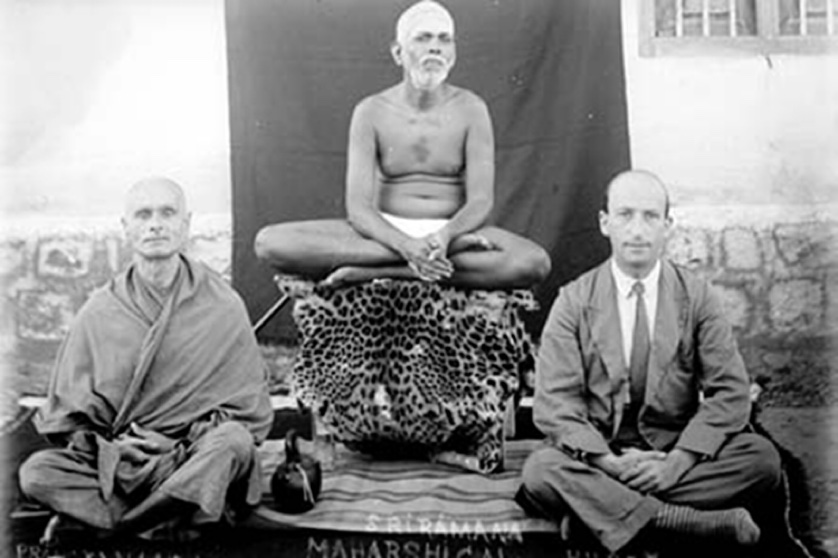
This was Frederick Charles Fletcher, an Englishman with a military background who spent his later years as a Buddhist monk under a name of Prajnanda (or Prajnananda). His presence at the Ramanashram during the winter of 1930-31 has been noted by scholars such as Glenn Friesen, Kevin R. D. Shepherd, and Stephen J. Castro, who have investigated the background to PB‘s Search in Secret India. This report offers some conclusions and hypotheses about Fletcher and his place in PB‘s biography.
Fletcher‘s parentage, youth, and civilian employment are currrently a blank. The nearest thing to an official biography was written by Christmas Humphreys, the indefatigable promoter of Buddhism in England, recalling Fletcher‘s visit to London in July 1926:
The Bhikkhu Dorje Prajnananda
To return to a memorable month. A surprise visitor to the Lodge was the Venerable Dorje Prajnananda, who was bom in London in 1877 as Frederic Fletcher. While a student at Oxford, he read the Light of Asia, and later went on a holiday to Ceylon. There he was introduced to the High Priest Sumangala and the Anagarika Dharmapala, and studied the Dhamma under their care. From Ceylon he went on a lecture tour in America and then returned to England, where he entered the Army. During the War he rose to the rank of Major, but the suffering and death he witnessed made him resolve to leave the world and enter the Sangha as soon as the War was over. In 1922-3 he went with McGovern, Ellam and G. E. O. Knight on a long expedition into Tibet where he stayed for a year at Shigadze, and had audience with the Tashi Lama. He entered the Yellow Cap Order as a samanera-the first Englishman to do so-but returned to Ceylon in 1924 for Ordination into the Sangha of the Southern School. As a Bhikkhu he travelled on foot the length and breadth of India, following from point to point the holy places of Buddhism. Then, hearing of the beauty of Burma, he made Rangoon his headquarters, and, save for periodical pilgrimages in India and the Himalayas, and this trip to London, has worked there ever since. His fiery eloquence is remarkable, and should he ever return to England he would be the most powerful Buddhist preacher of the Dhamma we have ever heard. Would that he had been able to stay with us, but he had to return to Burma, and left us all too soon.2
Two photographs sent with greetings to PB and his wife Karen, preserved in the PB Archive, date from this period.
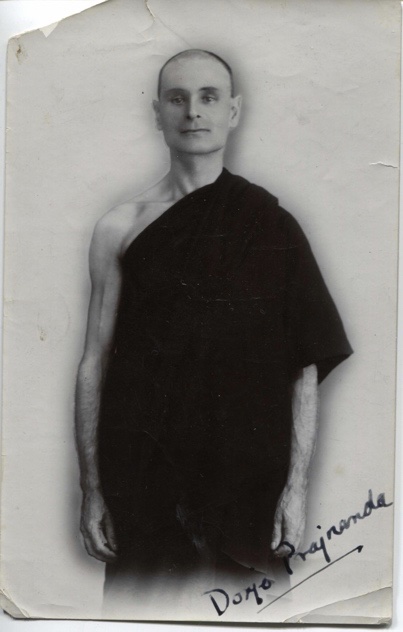
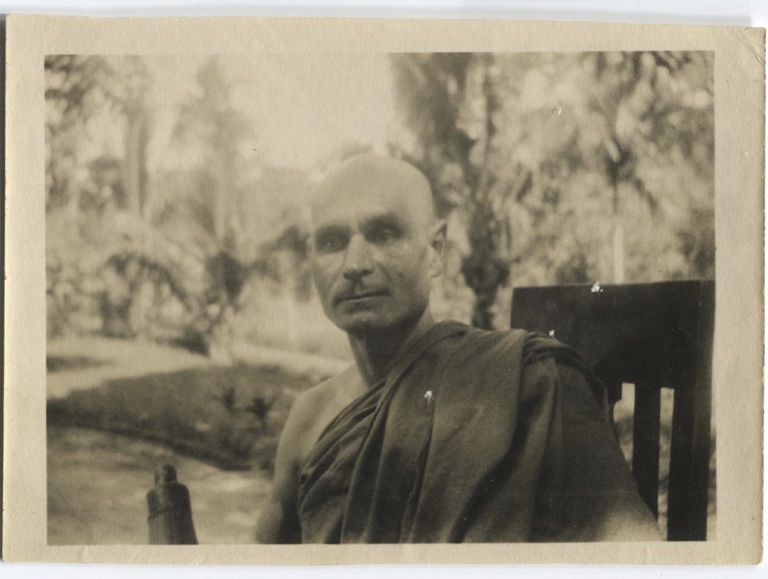
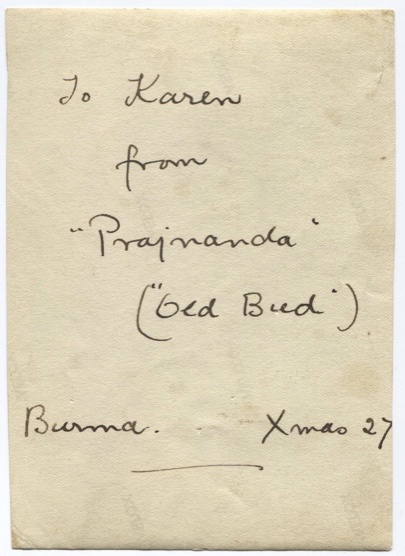
While Humphreys, a High Court Judge, can be trusted as to what his visitor told him, none of it can be credited without independent verification-no easy task. Oxford University‘s records list only graduates of the Honors Schools, not those with less scholarly ambition who earned a “Pass” degree. The British Army lists for the First World War were partly destroyed in the Second, though more of that below. The only clue about Fletcher‘s pre-military employment comes from a later statement that in 1913 he was made an Associate Member of the Institute of Mechanical Engineers3. This would have required a degree or other professional qualification. In Fletcher‘s time, Oxford had neither an engineering faculty, nor training for Methodist ministers, as claimed in the same report.
We can at least note a resemblance to the biography of Allan Bennett (1872-1923), another scientist who was drawn to Buddhism at an early age through reading The Light of Asia. In 1901, putting occultism and magick behind him, he moved to Ceylon and entered the Sangha under the name of Ananda Metteya or Maitreya. In 1903 he founded the International Buddhist Society in Rangoon, Burma, and in 1907 brought his mission back to the West and founded the Buddhist Society of Great Britain and Ireland.
If Fletcher was so interested in Buddhism-and his later life proves his seriousness-he would have known of Bennett and the London society. After the war PB acted as helper and secretary to the severely ailing Bennett. During that time Fletcher and PB were friends, and for a while even shared a flat. In later conversations, PB remembered Fletcher as an expert on the Secret Doctrine. Without being certain of who met whom, when, and how, my loosely-held hypothesis is that Fletcher, already connected in London‘s Buddhist and Theosophical circles, introduced PB to Bennett, who remained one of PB‘s guiding lights.4
Some events of the immediate postwar period appear in an “Occult Autobiography” by Michael Juste.5 That is the subtitle of The White Brother, whose author was Michael Houghton (born Michael Hurwitz), poet, essayist, and bookseller. He and PB had been friends from youth, and by 1920 both had joined the Theosophical Society. They started a bookselling business that later, under Houghton‘s direction, became the Atlantis Bookshop, still existing near the British Museum. The White Brotheris a mixture of fact, fantasy, and poetic effusion. Judiciously read, it is a window into that period in PB‘s life, and especially his apprenticeship in occultism to the adept known as “Brother M” (Charles Willis Thurston, the subject of another investigation). The book tells the story of a group of young men with spiritual aspirations, living hand-to-mouth in a basement flat, the former kitchens of a large terrace house in Bloomsbury. This is corroborated by PB6, who was probably the model for the narrator‘s closest friend, here called “David.” For a while, they share their flat with an older friend, an Irish ex-serviceman of irascible but endearing character, who counsels them in the ways of this world. He is partly modeled on Frederick Fletcher, who gave the book his warm approval (see below).
This period of Fletcher‘s life ended in 1922, when he was engaged by the British Expedition to Tibet. The members were photographed on July 13, 1922, on their departure from London‘s Liverpool Street Station. From left to right they are Frederick Fletcher, William Montgomery McGovern, William Harcourt, and George Knight (the fifth member, J. E. Ellam, is not shown).7
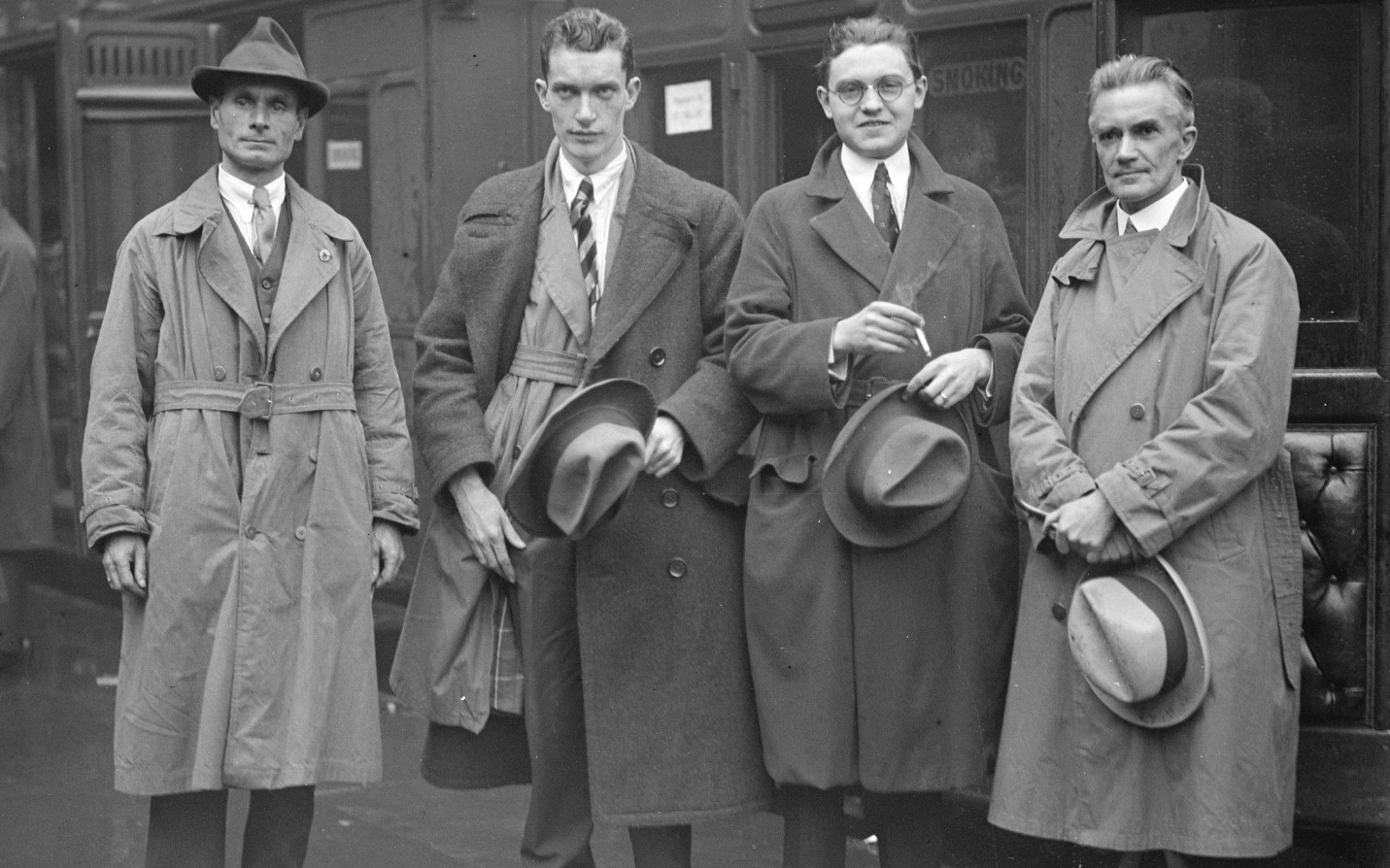
The Guardian newspaper of that date gives some information on the members, significant as much for what it does not say. G. E. O. Knight, the leader, has organized expeditions in different parts of the world. Captain J. E. Ellam, co-leader, is Secretary of the International Buddhist Union and General Secretary of the Buddhist Society of Great Britain and Ireland. Dr. William Montgomery McGovern, of Christ Church, Oxford, is interpreter and general adviser, lecturer in Chinese and Japanese at the School of Oriental Studies, University of London, and Vice-President of the Buddhist Society of Britain. Mr. Frederick Fletcher is scientist and transport officer. Harcourt is named elsewhere as the expedition‘s cinematographer, hoping to bring back the first motion-pictures of the forbidden kingdom.
Knight‘s idea for the expedition had been inspired by those of Sven Hedin, the Swedish explorer who had narrowly failed to reach Lhasa. It took Knight fifteen months to raise the funds, which came eventually from William Dederich, sponsor of Ernest Shackleton‘s Antarctic Expedition of 1914. According to a later report, the expedition was also under the patronage of Annie Besant‘s Theosophical Society8.
Afterwards McGovern wrote a 462-page book about the expedition9, and Knight a shorter one10. Fletcher, with his function of Transport Officer, appears in both, though not as “Major Fletcher” as he was later known. Whereas Ellam is called “Captain Ellam,” our man is merely called “Mr. Fletcher.” His true rank appears in an incident related by Knight. On a dangerous mountain path, one of the mules fell over a precipice. The Transport Officer‘s mule nearly followed it, “but he was a Sergeant-Major, and just knew how to pull himself together and address his mule in terms that only Sergeant-Majors know how.”11 Sergeant-Majors are non-commissioned officers, far down the pecking order from Majors. Senior officers and civilians address them as “Mr. so-and-so.” They are typically charged with training and disciplining recruits. That was just the sort of man the expedition needed to control mules, coolies, etc.
Possible corroboration comes from the British Army records for the First World War, which list two Frederick C. Fletchers, or the same man twice: one in the Royal Engineers, the other in the Labour Corps. In both entries his rank is Company Sergeant Major.12
The British and Indian authorities allowed the expedition to go as far as Gyangtse, where the British maintained a trading post. Once there, they were obliged to apply to the Tibetan authorities for permission to proceed the 150 miles to Lhasa. If this was denied, they were honor-bound to return immediately to Darjeeling. Such was the case, and the end of the expedition as such, though it had gathered much information and experience. The fact that William McGovern then made a secret solo trip to the Tibetan capital, and perhaps met the Dalai Lama XIII, cannot distract us here, except for its significant dates. He confided his plans only to his four English friends, and left on January 10, 1923.13 He returned to Darjeeling on April 17, 1923, and as he specifically says, rejoined Knight, Ellam, and Fletcher there.14
This clouds Fletcher‘s claim to have spent a year in a monastery in Shigatse and had an audience with the Tashi (Panchen) Lama15. If he managed to slip up to Shigatse and back between January and April, not even his companions ever heard about such a feat. More believably, he claims then to have spent three years as a wandering sadhu, tramping the length and breadth of India, then settling in Rangoon under the name of Dorje Prajnanda. The terminus for that period is set by his presence at the Buddhist Society of London by the summer of 1926, testified in Humphreys‘ biographical note quoted above. To be precise, Fletcher lectured there on “The Universal Buddha” on July 12 and 26, 1926.16
On the more intimate side, Kenneth Thurston Hurst relates that “Bud” Fletcher, while visiting London, lived with his parents in their small flat, but did not stay long because his mother could not stand Bud‘s uncouth habits. Nonetheless, she remained fond of him and continued to correspond.17
Fletcher recalls this trip to London in a typewritten letter of May 28, 1927 to Michael Houghton.18 He praises The White Brother and at the end mentions the basement flat in the former kitchen, and the wicked occultist “S” whom the group unmasked. He was evidently not offended by the character based on himself. The text follows.
Rev. Prajnanda, c/o Col Green, KALAW, S.S.S. BURMAH, May 28 [1927].
Dear Michael,
About a week ago I recd your book “The White Brother”. I have read it twice carefully and
I THINK IT IS A MOST EXCELLENT BOOK.
First, it is well printed on good paper & well got up. The language and descriptions show high literary ability. IN PLACES THE STYLE WOULD EQUAL SOME OF THE FINEST EXAMPLES OF ENGLISH LITERATURE, and very important too, the occult teaching is some of the “real stuff” & not the “bunk” that is usually written. I read it with great pleasure & shall pass it on to some of my friends here. The only criticism I have to make is the poem at the end, which is far below some of the high quality in other parts of the book.
You say you are writing a novel. I’m rather sorry, for I feel you should do something more instructive. You remember the book “Tertium Organum” by Ouspensky. Well, that gave a new philosophy to the world, new ideas & also had a big sale which brought cash to the author. If you can give new IDEAS to the world I feel your DHARMA lies in that. The market is overstocked with novels. I believe yet you will get some BRAINWAVE that will bring a new conception of life and thought. Remember NEITZCHE, [sic] If you can go one better & evolve a SPIRITUAL RATIONALISM, my boy, your name is made.
I met many big philosophers here & know what the East thinks. It has great regard for the thought of the West. I do hope one day you will be able to visit these parts. I feel your whole vision would expand enormously, as it has done with others.
Now with regard to “M”. A year ago I had an inspiration to come to Europe. With terrible difficulty I managed to raise my fare & have now ruined myself for the rest of life. But I felt I had to come. Some link had to be made by the Group between East & West. I came to London. While there it was the duty of “M” to meet us & so form this link which would have made a great difference to him & us. IN THIS HE COMPLETELY FAILED AND WILL YET REGRET IT. I came back here having wasted my time & money. If he had only met us for an hour I feel some link would have been made. I therefore have little respect for him for he failed in a spiritual DUTY, and if I ever meet him I shall tell him so. I HOPE YOU WILL TELL HIM WHAT I HAVE WRITTEN. I am now a Buddhist monk wearing the Yellow Robe & therefore have the right to criticism in these matters. I have very great admiration for your book, but I’m afraid your teacher still has a very human side.
Well I’m still living up in the mountains It is very beautiful. I spend much time in the forest. The oranges & pomegranates are just beginning to ripen. I am doing nothing with my book as I’m busy writing for the Buddhist papers & social reform in India. I want to go to Benares again in the Winter if I can raise the cash. It was very good of you all to send me your book & I thank you all very much, but probably one day I shall return it for I feel an author cannot afford to give books & I will sign it & you can keep it as a link between us. I feel fairly well but sometimes begin to feel old. I wait your next letter with much pleasure. I hope the “W.B” will bring you in something for it is a splendid production. I often read Passages at night before going to sleep & get some inspiration, And now it brings back old memories of the “Kitchen” & the pseudo Adept “S”
Good Bye dear Michael. Best of Luck
Fraternally
Prajnanda
Incidentally, Prajnanda is the original version of Fletcher‘s Buddhist name. This is how he signs himself on the letter, and on the backs of the two photographs in the Paul Brunton Archives, shown above. In 1928 Buddhism in England calls him “the Lama Dorje Prajnanda,” and is said to be shortly publishing Strange Adventures in Tibet19. That would have made a third account of the British Expedition, but there is no sign of it. Later his name is written Prajnananda, a more correct elision of prajna(wisdom) with ānanda(bliss).20
Fletcher‘s Indian wanderings after the Tibetan expedition (1922-25) would have given him ample opportunity to learn of and meet Ramana Maharshi. Perhaps he told PB about Ramana during his London visit of 1926, and even outlined a possible “search in secret India” that they might undertake together, if PB could raise the cash. Stephen J. Castro, in his essay of 2013 put the matter succinctly: “It is evident that Brunton had kept in contact with Fletcher, and had arranged to meet him in India, where the latter acted as guide for his friend, and introduced him to Ramana Maharshi.”21
On December 3, 1930, soon after his arrival in India, PB wrote to Brother M, who replied on January 25, 1931: “Kindly remember me to Mr. Fletcher – I think that he will like yourself go to America in the future for he would feel at home there and his costume would make him attractive to the ladies.”22 The mildly catty remark was merited, if M had any inkling of Fletcher‘s attitude to him.
If Fletcher did not actually meet PB off the boat, he accompanied him for three weeks among devotees of Meher Baba, as chronicled day-by-day in the “Account of Mr. Hurst‘s Tour.”23 PB and Fletcher, treated as VIPs, set out with Baba‘s brother on November 24, 1930. They visited schools, addressing the pupils, and sites of interest including the Theosophical Gardens in Adyar and the Ramakrishna Math. On December 7, Fletcher spoke to an assembly on “Shri Meher Baba and His Work,” and PB lectured on the Meaning of Life. The reporter, like Christmas Humphreys, praises Fletcher as “a born orator.” The devotees were thrilled by the enthusiasm of the English pair. Was that enthusiasm faked? It would have been hard to keep it up for three weeks. I suspect that PB‘s disillusion came later, after he had actually met the silent avatar.
Secret India tells thatafter his first meeting with Baba, PB is advised to seek out Ramana Maharshi, first by a hefty, yellow-robed yogi, ex-Indian Army,24 then by the Shankaracharya.25 Fletcher gets no mention in the book, but he visibly inspired this character, as he had done the White Brother‘sIrishman. A letter from PB to Baba, written on Dec. 30, 1930 and kindly released by the Meher Baba Foundation, is as close to the truth as we are likely to get. It indicates that he and Fletcher had gone to Tiruvannamalai (Ramana‘s home). Here is an excerpt from the letter:
First the Bhikkhu Prajnananda become ill and irritable and had to have doctor‘s attention. He is fairly well now again, but it was the travelling which does not suit him: he wants to rest since he came all the way from Burma. So at his request I wrote 2 letters to you to ask permission to leave out some of the places on our list, so he should have less journeys to make. You were away so Dastur said I should act as seemed best. So I omitted going to the extreme South (viz Rameswarm, Madural and Mysore), we did however visit Tiruvannamalai instead. Then the Bhikkhu asked me if I could finish the tour myself, and I agreed that I was now so accustomed to Indian travelling conditions that I could quite easily carry on myself henceforth. So at his request I left him at Madras, just before I left for Calcutta 2 or 3 days ago. I gave him sufficient money for all his needs and he has gone to some place near Tiruvannamalai until I complete my tour when he will come later to Nasik.26
Whatever had happened then, it ended their friendship. After his return to London, PB wrote to Michael Houghton on August 3, 1931:
I also received a letter, very insulting, from Bud. He requests me never to correspond with him in future. I heartily agree with this request as I am quite fed up with him. As you know he is slightly mad, shell-shocked and unfit for human society. He is also very ungrateful after what I did for him in India. However I am only too pleased to be rid of him. (Houghton Letters).
Fletcher may have returned to Ramana‘s ashram more than once. ON August 13, 1933, the Sunday Timesmentions him as having been there “last winter,” which would be 1932-33, and hoping to return “next year.”27 That remains unconfirmed for now.
He reappears on December 6, 1941 in the Melbourne newspaper The Age, in an article by a distinguished radical journalist, W. G. Burchett.28 The writer, already in Rangoon, had been intrigued by seeing the address of an “English Monastery, University Avenue, Kokine,” and decided to investigate it. He was not disappointed, for Fletcher was in a communicative mood. He was apparently born in London 61 years ago [i.e. 1880], and was a graduate of Oxford, where he studied to become a Methodist minister. He was a Major in the army, and took part in the battles of the Somme and Ypres. When the Tibet expedition was turned back, he entered a monastery in Shigatse and stayed there for twelve months. After McGovern was “jailed” in Lhasa, Fletcher was advised to flee to India, and trekked the 400 miles there. He stayed some months in Darjeeling, then undertook a three-year pilgrimage from Calcutta to Bombay and Ceylon, owning nothing but his staff and a begging-bowl. For nearly eighteen months he lived with the Yogis, including the ones who wore nothing but ashes, and studied under Ramana Maharshi. Ten years ago he made a brief lecture tour to England and America. He believed that Fascism and Nazism could never be victorious, because they are against the spirit of the four great faiths, Christian, Muslim, Buddhist, and Hindu. The article includes the photograph with a parasol, shown below. The reader may compare this summary with the other information gathered here.29
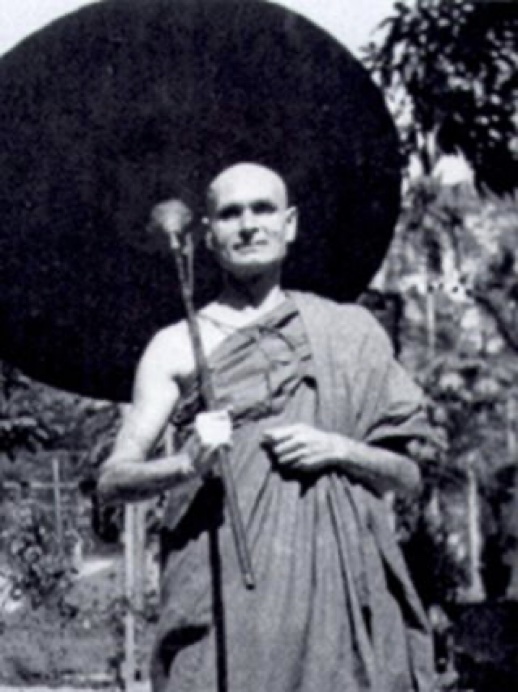
The next, and to my knowledge the last record of an encounter with Fletcher comes from a pair of sources, one factual and the other fictitious. They were written by two men who in 1948-49 undertook a flight from Britain to Australia and back in a single-engined Proctor V airplane. One of them, James Riddell, was an athlete, author, and adventurer who had spent the war on duty in Palestine. The other was Nevil Shute, a best-selling novelist (e.g. of the prophetic post-nuclear novel On the Beach) and also an aircraft expert, who owned and piloted the plane. While in Rangoon, Riddell sought out Fletcher at his ashram. Shute probably accompanied him, though he is not mentioned in Riddell’s account, which includes the photograph below:
October 25th[1948], Rangoon. Finished working on the aircraft in the early afternoon, then went to visit a great rarity-an English Buddhist Priest-U. Prajnananda-alias Major Fletcher, R.E. [Royal Engineers] For twenty-seven years he has worn the yellow robe and carried the begging bowl. He has walked across India, Tibet, and Burma, and he now, at seventy, lives in a tumbledown Basha on a small hill-top on the outskirts of Rangoon. We sat under some bamboos on old boxes and a broken-down deck-chair and talked to him-and got bitten to hell by mosquitos. He knew about the subtler planes and about the etheric body, and about the continuity of existence-and it was very interesting to listen to him and to hear what one knew one ought to hear. Probably because I know nothing whatsoever about Astrology, and do not much care for the subject, the stuff he talked on those lines simply was just stuff.
According to him, a new Great Teacher will begin teaching in about 1960-70. He will be born (if he has not already been born) of Russo-Indo-Tibetan stock. He will be educated in the West-in the U.S.A.-and will set up centres of learning in California, Switzerland and Northern India. All of which is fine-and I am in no position to offer comment. It is all too easy to label something one does not understand as eccentric-or someone who says he does understand as being in need of having his head examined. Anyone who lives alone for a very long time, with only seven possessions-a robe, slippers, begging bowl, umbrella, spectacles, razor, beads(?)-and does little else but meditate, is liable to come up with a few answers that are not easy to understand. Nothing is lost by listening and nothing is gained by condemnation. He was very interesting on the decline of Buddhism, and the decline of other religions as well. We did not get on to the subject of Karma, but it was all there, sticking out a mile. It was a very interesting talk. Here is a man who has nothing, and wants nothing-and is, to all appearances, completely contented. They do not grow on trees.30
Both Riddell‘s and Shute‘s books have as their discreet subplot the longing for a new kind of spirituality, free from sectarian divisions and blending the best qualities of East and West. Shute‘s novel describes a meeting in Rangoon with an English Buddhist under the name of U Set Than. No longer a mere Major, “The old man had been a Colonel Maurice Spencer in the Royal Army Service Corps in the First World War, and had come to India after that for the prosaic job of organizing a service of lorries in Bengal. Within two years he had become a Buddhist and had achieved a small circle of Indian Buddhist friends in Calcutta.” The old “Bud” emerges when the narrator asks if he has ever returned to England. “He said, once, in 1936, but he found the world set upon the wrong course and was glad to return to his quiet ashram on the outskirts of Rangoon. I asked him what he wore in England, and he said, ‘Well, that‘s a damn fool question. Do you think I walk down Piccadilly looking like this?'”31 Although this is only a brief episode in the novel, it is plain from Russell‘s account that Shute‘s whole plot was inspired by Fletcher‘s prophecy. The narrator‘s boyhood friend Constantine Shaklin, is Russo-Chinese in origin, English by upbringing. In the course of the story he develops from an aircraft mechanic into a proto-New Age messiah, to whom crowds flock from all corners of the earth until his early death.
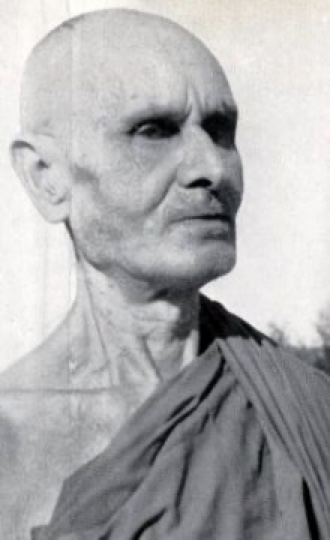
By the time Round the Bend was published, Prajnananda was no more. His obituary appears in The Straits Times, January 13, 1951, with the title “War-Sick Soldier Turned Priest” and the byline “A.P.” (Associated Press). It gives his dates: born in London on June 7, 1884, died on December 28, 1950. It mentions the Tibet expedition, after which Major Fletcher stayed behind to wear the yellow robe and study Mahayana Buddhism. He came to Rangoon in 1924 and lived for 25 years in a “mat hut.” When the Japanese invaded in 1941, he was jailed as a British spy, sentenced to death, released, re-arrested on the testimony of another Buddhist monk, tortured, and released again. A shorter version appeared the same day in The Malaya Tribune, headlined “Even the Japs Found Him ‘Innocent‘.”
His cremation, attended by the highest Buddhist priests, was celebrated by the Latvian Buddhist Archbishop Karlis Tenissons, whose eulogy carried a sting in its tail: “He put aside the pride of his race and became an internationalist in the true sense of the word. He richly illuminated the fact that all Englishmen are not obsessed with a superiority complex.” Amazingly enough, this archbishop had also played a crucial part in PB‘s philosophical development, which is the subject of another investigation.
Fletcher may have been, in PB‘s words, “slightly mad, shell-shocked and unfit for human society.” It seems only fair to add that Bhikku Prajnananda went far to redeem the difficult character that karma had bestowed on Bud Fletcher. He probably introduced PB to Allan Bennett, certainly to Ramana Maharshi, and perhaps even to the mysterious “Mongolian” whose philosophy is celebrated in The Wisdom of the Overself.32 To close the circle, in 1959 Kenneth Thurston Hurst, while on publishing business in Rangoon, was handed Prajnananda‘s mortal remains-half a pair of spectacles and an urn of ashes-which with some difficulty he brought home and enshrined at the London Buddhist Society.33
1 In 1920, PB joined the Astrological Lodge of the Theosophical Society. A mention of Fletcher in later life still talking about astrology (see below) raises the possibility that this was their locus of meeting.
2 Christmas Humpheys, The Development of Buddhism in England (London, The Buddhist Society, 1934), p. 64. Accessed online.
3 W. G. B[urchett], “British Major, Buddhist Monk, Strange Career of Frederick Fletcher,” The Age (Melbourne), December 6, 1941. Accessed online.
4 I am not able to search for Fletcher in the London Theosophical Society’s handwritten membership records, as was kindly done for me by Leslie Price, finding there both Michael Hurwitz (late Houghton) and Raphael Hurst.
5 Michael Juste, The White Brother: An Occult Autobiography (London: Rider, 1927).
6 Notebooks vol. 8, p.220, note 127, with an understandable error. PB’s and Houghton’s flat was at 54 Tavistock Square (given as PB’s address on his and Karen Tottrup’s marriage certificate, Sep. 5, 1922), whereas on January 9, 1924 the Woolfs bought a ten-year lease on no. 52, two doors away. See Virginia Woolf, The Diary of Virginia Woolf, Volume 2, 1920-1924 (New York: Harcourt, Brace, Jovanovich, 1978), p. 282. The terrace was bombed in WWII and replaced by the Tavistock Hotel, which now sports a blue plaque naming the Woolfs, but not PB.
7 The Daily Telegraph, August 27, 2023. Accessed online.
8 The Age, see above, note 2.
9 William Montgomery McGovern, To Lhasa in Disguise (New York: Century Co./London: Thornton Butterworth, 1924).
10 G. E. O. Knight, Intimate Glimpses of Mysterious Tibet (London: Golden Vista Press, 1931).
11 Knight, 19.
12 Records accessed online.
13 McGovern, 66.
14 McGovern, 462.
15 Ven. Vorasak Candamitto, “Buddhist Origins in Great Britain” (Durham University M.A. Thesis, 1972), 19. Accessed online.
16 The Maha Bodhi Journal, May-June, 1927. Accessed online.
17 Kenneth Thurston Hurst, Paul Brunton, A Personal View (Burdett, NY: Larson Publications, 1989), 45.
18 Houghton Letters (Private Collection). This is presently the only known letter by Fletcher.
19 Buddhism in England, 2/9 (March 1928). Accessed online.
20 Thanks to Fr. Francis Tiso for the explanation.
21 Stephen J. Castro, “British Critics of Meher Baba.” Accessed online.
22 PB Archive.
23 Meher Message, 3/1 (January 1931). Accessed online.
24 Paul Brunton, A Search in Secret India (London: Rider, 1935) 114, 116.
25 Secret India, 130-1.
26 Meher Baba Foundation. Accessed online.
27 “Maharshi’s Foreign Bhaktas,” Sunday Times, August 13, 1933. Accessed online.
28 See above, note 2.
29 The article was reprinted with minimal changes, and the author’s surname given, in The Australian Women’s Mirror, March 10, 1942. Accessed online.
30 James Riddell, Flight of Fancy (New York: Duell, Sloan & Pearce, 1951), 72-73.
31 Nevil Shute, Round the Bend (New York: William Morrow, 1951), 118-19.
32 See my investigation of “Paul Brunton and the Mongolian Philosopher.”
33 A Personal View, 144-146.

Czech

Spanish

Portuguese